
Hedgerow warfare during the Battle of Normandy
Battle of Normandy
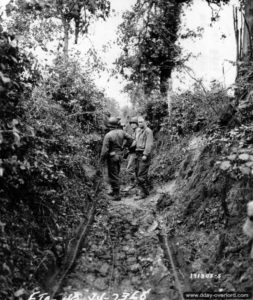
13th July 1944: sappers and signallers lay telephone cables between two hedgerows to the north of Saint-Lô.
Photo: US National Archives
Normandy was the scene of furious fights several weeks after June 6, 1944. After the battle of the beaches, what historians today commonly call the “hedge war” begins with reference to the particular nature of the terrain on which To evolve the belligerent forces. The hedge warfare, also known as the “bocage”, began as early as the day after D-Day and ended at the end of August 1944, when the Allied troops ended up liberating most part of the present-day Basse-Normandie. Virtually two months of deadly and fierce fighting that put men to the test. What are the specificities of fighting in the Norman hedgerow? Revealing many tactical and technical lessons for the military still today, the battle of hedges deserves a precise study, which combines areas such as geography, tactics or weaponry.
- Hedgerows in 1944
The very nature of the hedges in 1944 is not the same as it is today, physiologically as well as utilitarian. At the time of the Normandy landing, the hedges are on average five meters tall, a smaller height than today. Particularly well maintained, they have an economic role predominant in the region, which has largely disappeared these days.
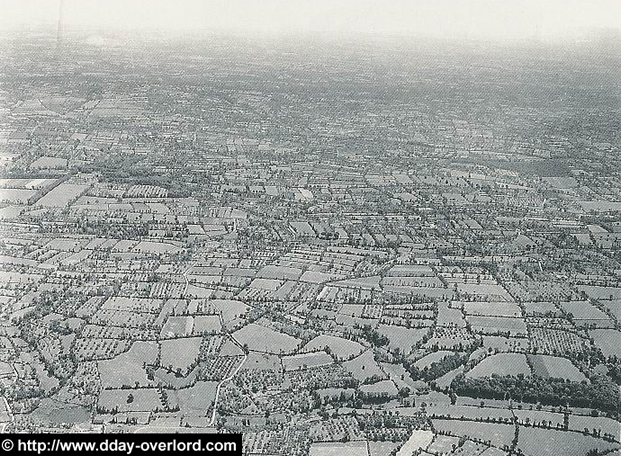
Aerial view of the Norman hedgerow in 1944. Photo: US National Archives
Indeed, if the hedges serve to delimit the properties and retain the flow of water, they also serve to keep the cows or the horses. Providing non-negligible food supplements thanks to the presence of numerous apple and pear trees in the region (which also make it possible to produce traditional alcohols such as cider, perry, pommel or calvados) which are either located within Of the hedges in the orchards which surround them, this vegetable mass bordered mostly by nettles and brambles is also a source of wood used for heating.
Difficult to cross the tortuous structure of the plants forming it, the hedge is in 1944 in phase with traditional Norman agriculture. Very widespread and part of the landscape, it influenced the tactics of the fighters during all the duration of the battle of Normandy.
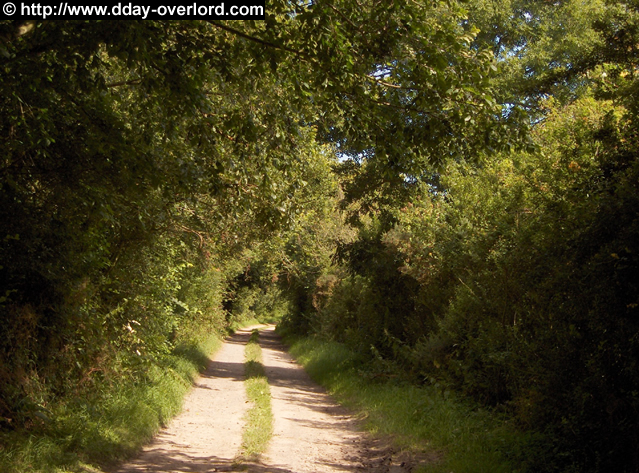
Contemporary view of a path in the Norman hedgerow.
- Tactical interest of the hedgerows
The structure and layout of hedges in Normandy is particularly unfavorable to the attackers.
A section leader must be able to achieve three points: see, shoot, maneuver. But as part of an offensive during the battle of the hedges, the attackers could very rarely have views of the whole terrain, the hedges also hid the lines of fire, while their impassable character greatly impeded the movements of the platoons and combat groups.
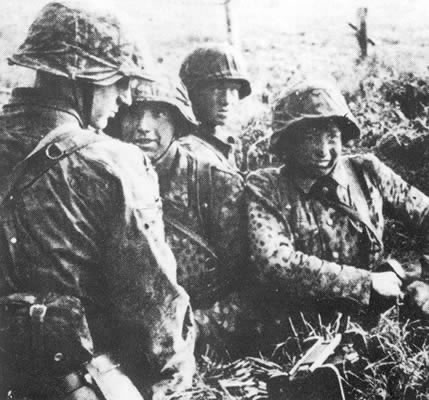
German Grenadiers of the Hitlerjugend, 12th SS Panzerdivision, near the town of Verson. Photo: Bundesarchiv
On the other hand, the soldier in a defensive position is in a strong position if he has taken into account the characteristics of the terrain. The Germans know the Norman hedgerow because it has been occupied for nearly four years. The maneuvers multiplied in Normandy and the teachings for the Wehrmacht and the armored divisions are legions. Soldiers as well as tank leaders learn to take advantage of the terrain, to camouflage their positions as best they can. On the one hand, they flood a large part of the land to the south and southwest of Veys Bay, on the other hand they judiciously avoid touching the hedges which form a natural wall. Only hedges in the immediate vicinity of fixed support points are cut for obvious reasons of observation and fire opening capacity.
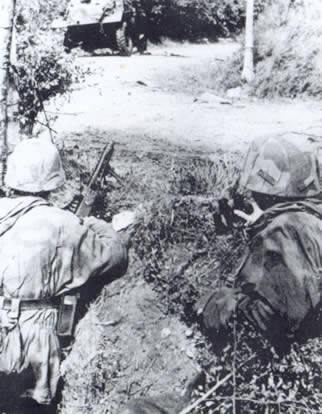
German soldiers in position with a MG 42 machine gun in the wood of Bavent. Photo: Bundesarchiv
If, as we have seen, a platoon leader must be able to see, shoot and maneuver, practically only the defense is capable of doing so. Before the battle, it can reference the best observation posts, the best firing positions capable of fixing and destroying the enemy as much as possible, and it can already mark possible folding paths to maneuver the fastest and most Efficiently possible. Numerous observation stations, sometimes concreted, such as tobruks, were equipped before the fighting with the coordinates of the places in the vicinity that the enemy would be able to borrow. All that was needed was to transmit these coordinates to the nearest artillery battery to stop the enemy’s progress, and this in a particularly fast time.
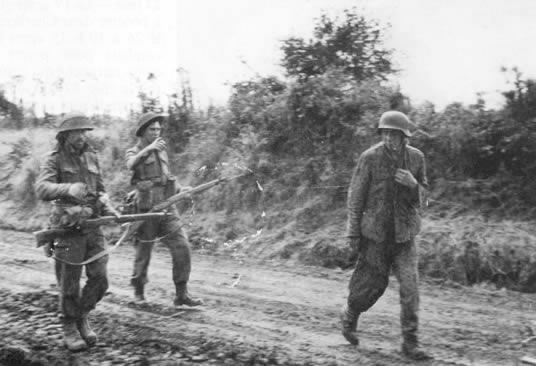
On June 28, a sniper of the “Hitlerjugend” surrenders to British soldiers of the 49th I.D. Photo: IWM
For the assailant, on the other hand, it is the reverse. Not knowing his ground, he must advance from one compartment of land to another, and each hedge is a fortress that must be dropped. The views are very limited and direct infantry support is consequently made difficult. If the range of some allied weapons is several hundred meters, the bocage greatly reduces this distance. Finally, the maneuver, from the very structure of the hedges, is extremely difficult for the one who does not know the details of the terrain, the possibilities of entry and exit of each field or orchard. The hedge, however, remains a non-negligible protection against infantry small arms, for the attacker as well as for the defender.
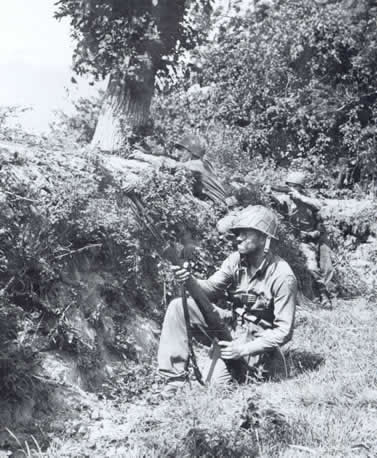
American soldier using his rifle grenade. Photo: US National Archives
- Hedgerow war
Hedge warfare began in the early hours of June 6, 1944, when American and Anglo-Canadian paratroopers and landed troops were immediately confronted with this vegetation. Allied gliders, loaded with men and equipment (ammunition, small vehicles, heavy weapons) hit the hedges in the same way that a car launched at full speed hits a wall: losses are worrying, material damage is also worrying.
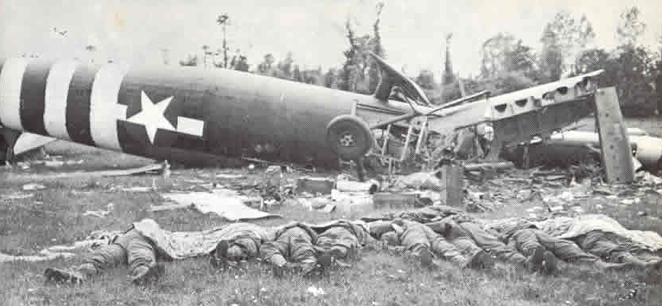
A glider crashed. 8 American soldiers were killed at the time of the crash. Photo: US National Archives
On June 6, 1944, German mobile artillery batteries used the hedges to accomplish their mission while camouflaging the views of the enemy aviation which could either destroy them or define their position and guide the firing of the enemy. Artillery embarked on the warships in the bay of Seine. This is particularly the case with the German battery installed in Brécourt near Sainte-Marie-du-Mont (Utah Beach).
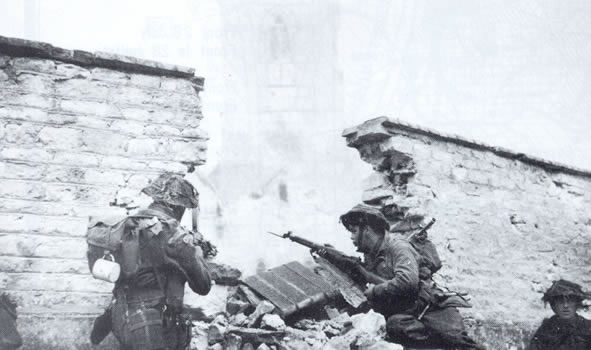
On 26 June, British soldiers observe downtown Saint-Manvieu. Photo: IWM
The end of the war of the beaches gives way directly to the war of the hedges. It was the Americans who were mostly confronted with this type of fight, because in the Caen region (where Anglo-Canadians have made progress) the terrain is largely composed of vast plains, conducive to armored combat. To the west, on the other hand, the Cotentin is largely compartmentalized in small orchards or cultivated fields bordered with hedges (also note that at the time, the cultivation of maize does not have the importance that is given to him today in Normandy). This is what the geographers really call the Normandy bocage. Anglo-Canadian soldiers, however, have also encountered this type of vegetation, but less recurrently than for the Americans.
The goal of the Americans being to cut the Cotentin in two to prevent the Germans from supplying and strengthening Cherbourg and its famous deep-water port, the 5th corps of General Collins literally runs through the hedgerow to rally the west coast of The peninsula. The advance, voluntarily accelerated, will be the cause of many losses among the American troops often taken by snipers or German artillery positions. Crossroads or bridges are crossed at full speed and when the effect of surprise does not work, the Germans put a stop to the forces disembarked using best the hedges.
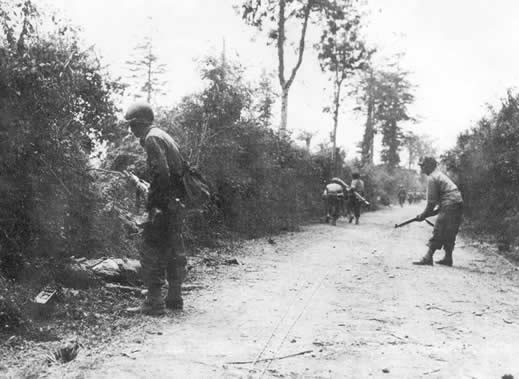
American soldiers during the fighting around Saint-Lô. Photo: US National Archives
Aviation played a central role throughout the Normandy campaign. Not only did it provide troop support to the ground, it also allowed enemy troops to be dislodged from their caches or prepared for offensives by means of extensive bombardments, usually concentrated in space and space. the weather. The most striking example is operation Cobra, which saw the realization of an intense bombardment to open passages between the German lines to pierce the front in the direction of Brittany. On July 25, 1944, the Americans applied the strategy of the carpet bombing: the carpet of bombs. 1,500 B-17 and B-25 bombers drop almost 3,300 tons of bombs between Montreuil and Hébécrevon northwest of Saint-Lô. But due to bad weather and the proximity of the friendly forces, dozens of US soldiers were killed during the bombing, with 111 dead and nearly 500 wounded.
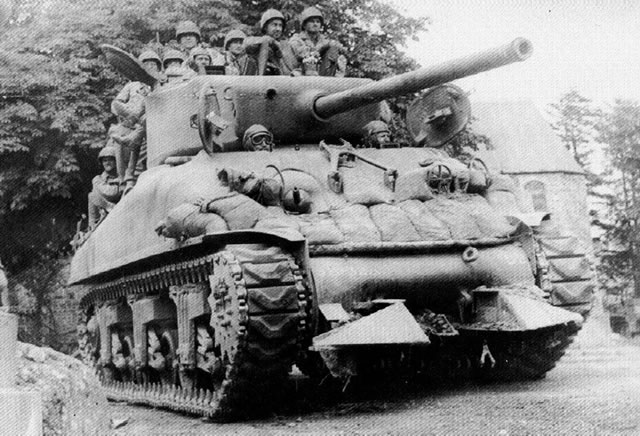
A Sherman tank with the “Rhinoceros” cutter facilitating the crossing of hedges. Photo: US National Archives
Allies must be ingenious to carry out their actions while being a minimum constrained by the terrain. To do this, they reinforce the means of communications linking the combatant and the artillery support or develop equipment adapted to the Norman hedgerow, such as the Sherman Rhinoceros, equipped with blades that make it easier to cross hedges ( See photo above). This invention made it possible to use the tanks during the progression through the various compartments on the ground, which was difficult to achieve without risking the premature loss of these craft (the ambushes allowing the Germans to attack as closely as possible and therefore very effectively armored vehicles).
- Conclusion
This study of the war of hedges in Normandy showed the peculiarity of the fight in the bocage and the tactical ascendancy of the defense on the attack. Allied military power overcame his opponent but at the cost of high losses and a significant delay compared to forecasts. These fights have shown the importance of supporting weapons (land and air artillery, aviation) which have generally succeeded in freeing assault troops from very delicate situations.
The Germans played the card of usury by prolonging the conflict: unable to resist the allied war machine, their actions delayed the advance of American, British or Canadian troops, without stopping it. However, German strategists did not benefit from this delaying action in Normandy. Indeed, Hitler was waiting for the decisive victory that could reject the Allies to the sea, while his generals advised a tactical withdrawal behind the Seine. This lack of lucidity and this loss of time benefited the Allies who were able to plunge into France and make great strides towards the total liberation of Europe.
Marc Laurenceau
 Back to the Tactics and Strategy menu