
M4A2 Sherman III Duplex Drive “Donald Duck” tank
History, technical sheet and photo
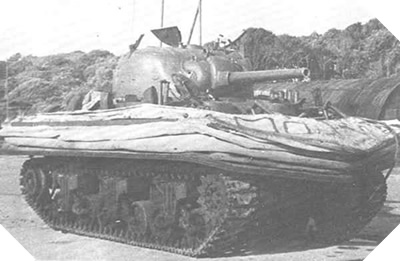
Duplex Drive tank history
In order to provide rapid and effective infantry support in the context of an amphibious operation or a river crossing, the US Army wishes to have armored vehicles capable of crossing a certain distance in the Autonomous way.
The British military engineers under the direction of the British General Percy Hobart then imagine a waterproof skirt surrounding the tank with propellers, so that the armored vehicle floats. They adapt this technique to the chassis of the Churchill chariot as well as to the M4A2 Sherman III which is presented here.
With the floating skirt up and the charter propellers in motion, the armored vehicle can reach the speed of four knots in calm weather. This tank, called Duplex Drive, carries the initials D.D. The American and British military quickly call this tank “Donald Duck” in relation to its initials and its capacity to float on the water.
When the DD tank reaches the shore, the floating skirt is lowered and the armored vehicle regains its earthly properties, thus supporting the infantry as close as possible during a landing or a river crossing.
Used during the Normandy landing and during the crossings of the Rhine, the Duplex Drive tanks make it possible to have a bridgehead with a high firepower, without using external means (ships, ports …) which may not be Available.
But the Duplex Drive can hardly navigate by a dismounted sea, as is the case during the Normandy landing, and most of the gear deployed on Omaha Beach flows at times, sometimes with their crew.
The Duplex Drive tank is one of the “funnies“, a nickname given by the British and American military to the engines invented by the British General Percy Hobart and intended to best support the land forces during the landing of Normandy.
Duplex Drive tank specification
Creator: Britain
Users: Britain, United-States, Canada
Denomination: M4A2 Sherman III DD (Duplex Drive)
Length: 6,06 m
Width: 2,62 m
Height: 2,74 m
Weight: 31,600 kg
Maximum speed on land: 34 km/h
Maximum speed at sea: 4 knots
Operational range: 160 km
Main armament: one M3 75 mm gun
Secondary armament: one Browning 7.62 mm machine gun for the co-pilot and one Browning 7.62 mm machine gun in the barrel axis from the turret
Engine: 410 hp GM 6046 diesel engine
Consumption: 279 liters per 100 kilometers
Crew: 5 (commander, gunner, loader/radio operator, driver, co-driver/hull gunner)
Chassis armor: 50 mm (front), 38 mm (rear), 38 mm (flancs)
Turret armor: 75 mm (front), 50 mm (rear), 50 mm (flancs)
 Back to the Battle of Normandy tanks