
Atlantic Wall in Normandy
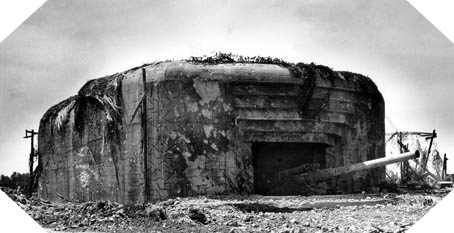
Crisbecq Battery – Atlantic Wall in Normandy
Photo: US National Archives
 German coastal artillery in Normandy German coastal artillery in Normandy |
Todt Organization |
| German strongpoints in Normandy |
Bunkers typology |
General presentation of the Atlantic Wall in Normandy
- Todt organization
Once France was invaded, the German forces launched an attack against the Russians, leaving a reserve of a dozen of divisions on the Western coasts of Europe. However, the German officers expected a landing in the West of Europe which would force the Axis armies to disengage the Russian front.
To prevent any landing, the Germans called upon the Organization Todt, a military company specialized in military constructions such as casemates, roads for armoured vehicles, etc. Dice 1941, works start opposite England, once the German attempt to invade England (Operation Sealion) was cancelled by Hitler. Concrete fortifications were built from Norway to the Spanish Country and allong the Mediterranean coast in France, accompanied by minefields, thousands of kilometers of barbed wires, flame throwers, machine guns, anti-tank ditches…
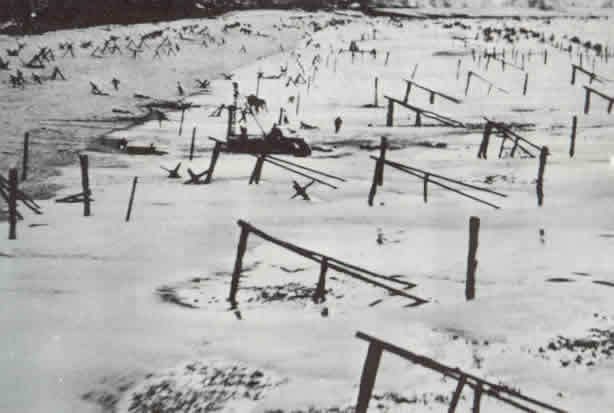
Beach defenses on the Norman coasts (allied reconnaissance aircraft picture). Photo: IWM
This fortification, very quickly called the “Atlantic Wall”, was reinforced in priority zones, opposite England for example, such as the Pas-de-Calais, where an ennemy landing is more than probable according to the German generals. Coastal batteries were built at key lcations of the coasts, to protect ports or estuaries.

German coastal artillery directed towards the open sea. Photo: Bundesarchiv
In August 1942, the Allies organized a “test” raid at Dieppe which failed because of the lack of reinforcements. The German staff officers became aware of the major risk to dismantle the coasts of the North-West of Europe: thus, 150,000 men of the German 15th Army stayed permanently in the Pas-de-Calais region.
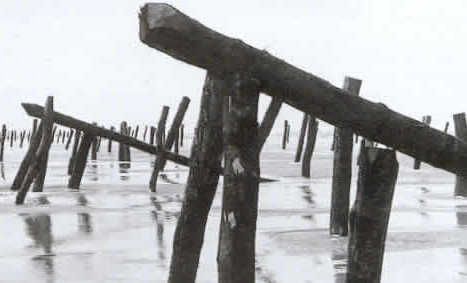
“Rommel’s Asparagus”, wooden beams supposed to breaking down the landing crafts. Photo: Bundesarchiv
- General Rommel
Since January 1944, Rommel (nicknamed “the desert fox” because of his victories in North Africa) became nervous. Under the orders of von Rundstedt, he was responsible for a difficult sector: the Normandy coast, facing the coasts of England.
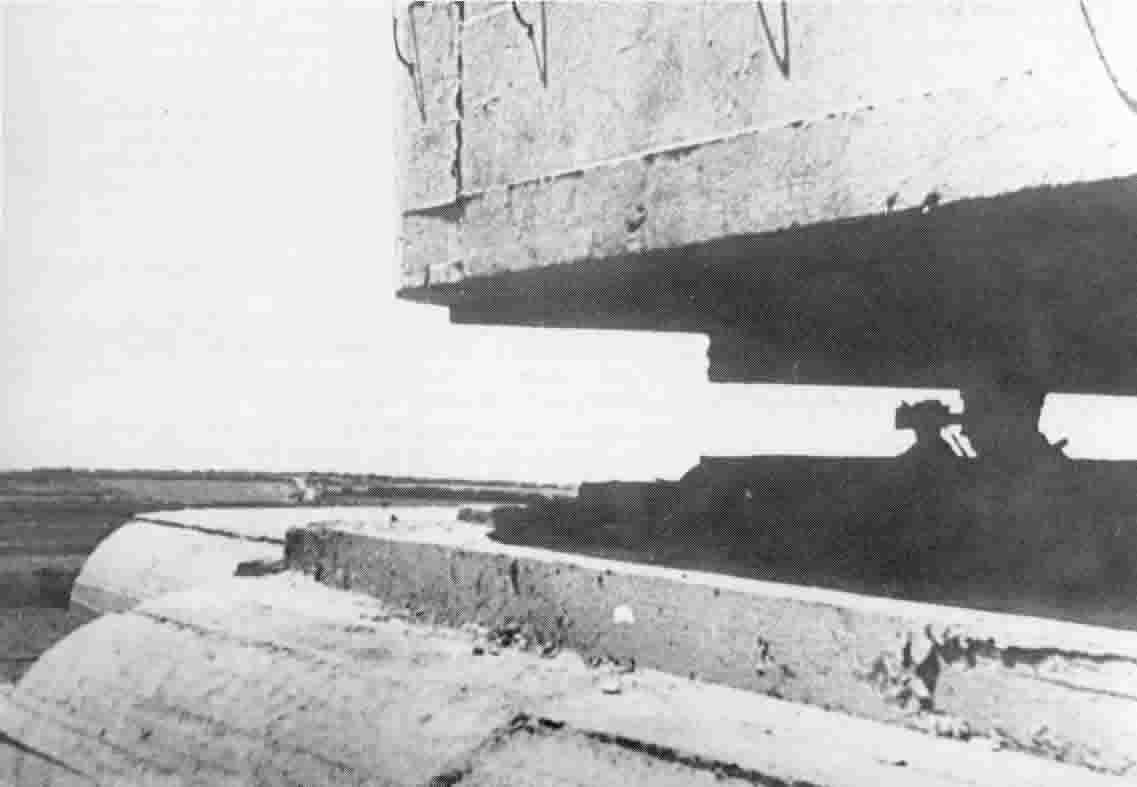
A German sentinel scanning the sea with his binoculars. Photo: Bundesarchiv
Rommel estimated that the defence system of his sector was not enough: he then decided to flood the meadows to prevent the arrival of parachutists, piles generally mined were planted on the Normandy beaches, intended to prevent the landing of gliders (the same device was installed inside the grounds) and the accosting of landing crafts. His experiment of the North Africa battles was beneficial for him and he knew that if the Allies managed to land on the coasts controlled by the Germans, it would not be possible to push the Allied back to England.
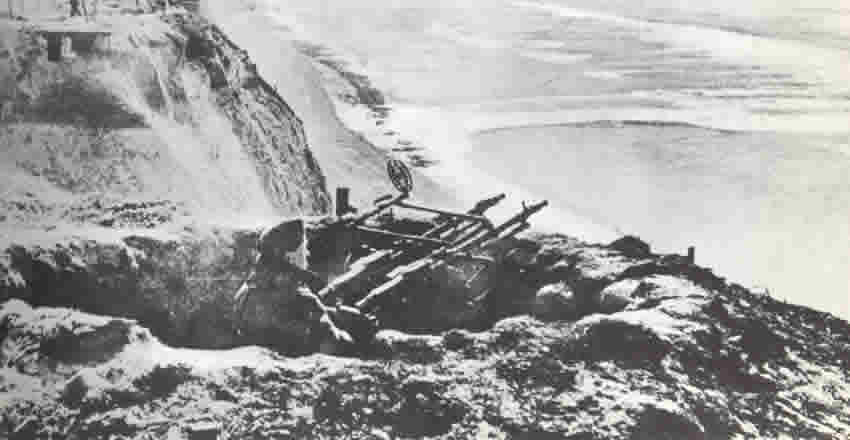
German defensive position with two MG 34 machine guns. Photo: Bundesarchiv
Thus the works multiplied mainly on the coasts of northern France and as far as the Netherlands. But Germany was still at war in Russia and in Italy: these two fronts required a very large quantity of raw materials and various military equipment.
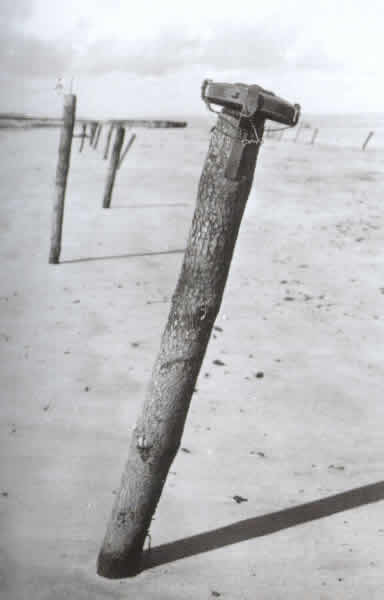
A mined pile, intended to prevent any aerial assault or naval disembarkation. Photo: NARA
The Todt organization launched several search operations throughout Europe to recover the maximum amount of material that could be useful during the construction of this gigantic “Atlantic Wall”.
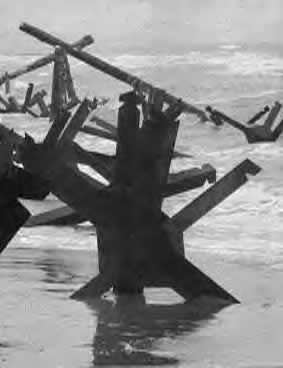
Beach defenses called “Czech Hedgehogs”. Their role was to destroy the landing crafts. Photo: Bundesarchiv
In Normandy, and as elsewhere, the Germans built coastal artillery batteries powerfully armed and protected by support points. Between Barfleur and Le Havre, there were no less than six batteries: Merville, Longues-sur-Mer, Pointe du Hoc, Maisy, Azeville and Crisbecq. They were capable of firing up to 30 kilometers.
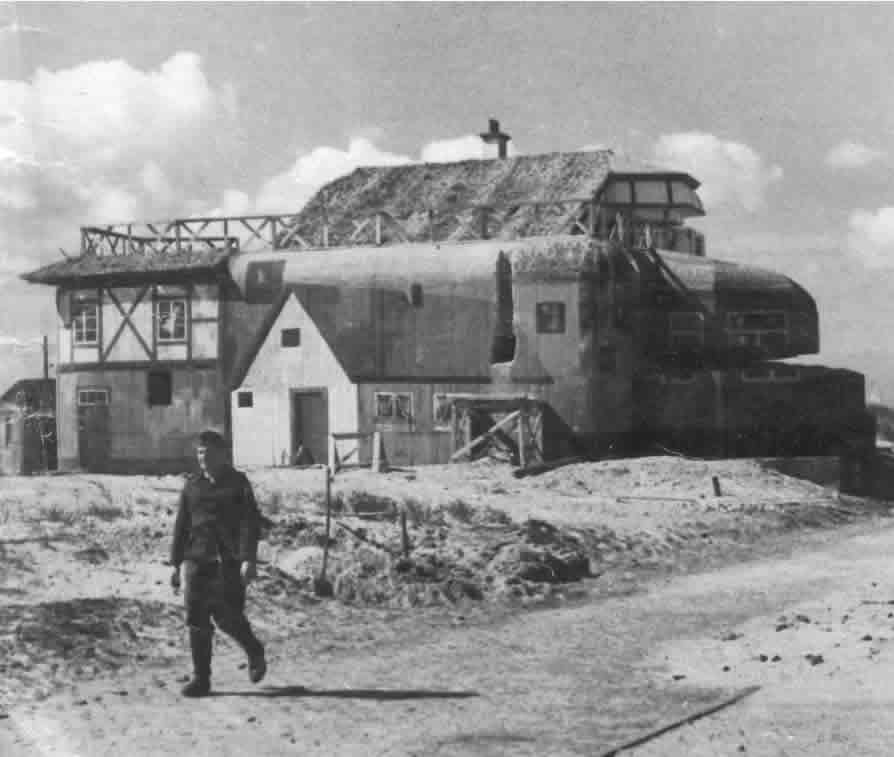
A German blockhouse camouflaged in Norman house to deceive the allied airmen. Photo: Bundesarchiv
- Eyes and ears
The Atlantic Wall was not only composed of blockhaus and minefields. Very many radar tracking stations were placed along the Western European coast from Norway to Spain, as well as listening stations. Between Cherbourg, Vire and Le Havre, the Germans built: 1 identification radar , 2 “Freya” type radars, 5 long range coastal radars, 7 mid-range radars and 14 “Wurzburg” type giant radars. Often, these radars were coupled with anti-aircraft guns, for example 88 mm guns.
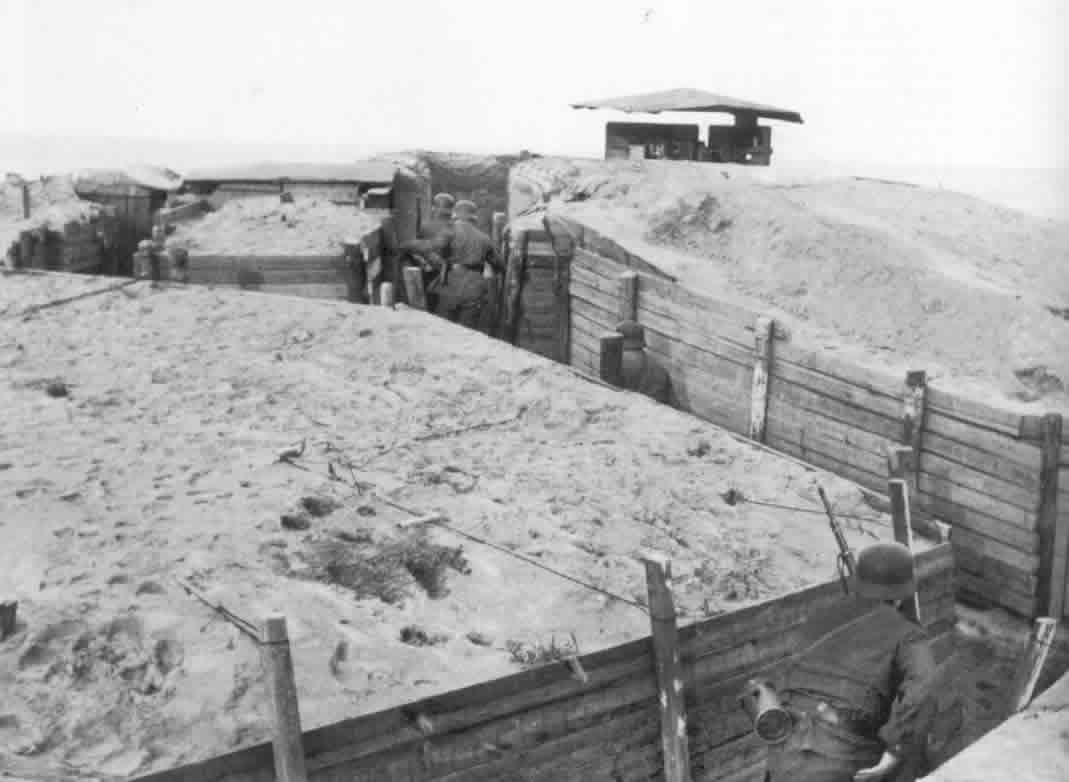
Trench network leading to the combat bunker over the beach. Photo: Bundesarchiv
To counter-attack in the case of Allied landing in Normandy, German military forces deployed three armored divisions and one airborne division, in addition to the conventional infantry divisions along the coast.
The latter were generally composed of units withdrawn from the eastern front and placed in Normandy so that these soldiers could rest.
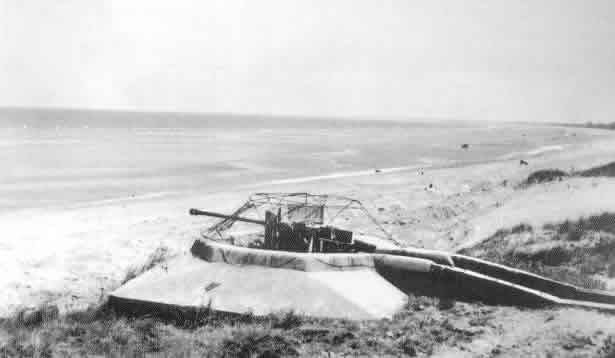
A 50 mm gun near the Francevile-sur-Mer strongpoint supporting the Merville coastal battery. Photo: Bundesarchiv
These Germans who were in Normandy lived to the rhythm of the allied bombings which regularly touched coastal objectives and reminded them that the war was not over.
It seemed clear, however, that the Allies would try to open a front to the west. But where and when?
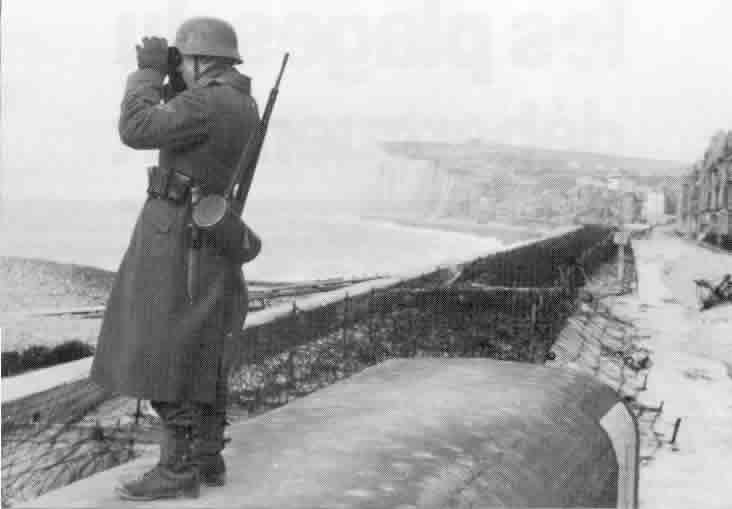
A German sentry screens the horizon, near its bunker at Mers-les-Bains. Photo: Bundesarchiv