
Operation Coup de Main
Horsa Bridge – June 6, 1944
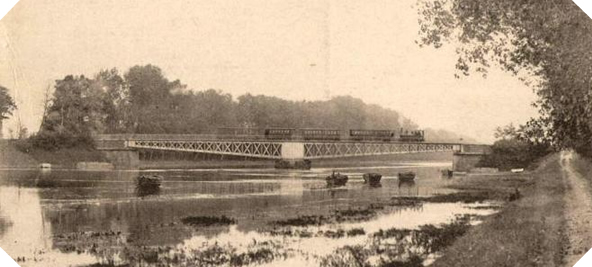
The Ranville bridge (renamed Horsa Bridge) on the Orne, before 1944
 Composition of the British gliders Composition of the British gliders |
Air transport serials |
- Preparations
The mission order, signed by General Gale commanding the 6th Airborne Division, was to: “to take intact the two bridges over the Orne River and the Caen Canal, at Bénouville and Ranville… The capture of these two bridges, which was to be known as “Operation Coup de Main”, relied essentially on the effect of surprise, speed of execution and determination to win. We will have to expect a counter-attack and hold on until the relief.
The aim of this mission was to seize these bridges and protect the eastern flank of the invasion, as there was only one crossing point for the Orne River and the Caen Canal, and this was located between the towns of Ranville and Bénouville: these two towns naturally became the main objectives of the British 6th Airborne Division.
Probably never before had a commando operation been so carefully prepared: two practically identical bridges in England were used to train a small group of about one hundred soldiers, all volunteers under the command of Major John Howard. This training, repeated many times, is according to Major Howard one of the most difficult in the British army. Jim Wallwork, one of the pilots of the three Horsa gliders that took part in the assault, containing about 29 soldiers with their equipment, recounts: “We had carried out numerous landing exercises, some in normal daylight conditions, some in daylight but with the windows tinted, and finally during the night.
The catch of the two bridges is coded “Euston I” for the Bénouville bridge and “Euston II” for the Ranville bridge. The latter, located 400 meters east of Bénouville, is a swing bridge allowing ships to cross the river Orne.
- Course of the attack of Euston II
Operation Coup de Main, part of Operation Tonga, started on 5 June 1944 with the take-off of the Halifax bombers towing the six Horsa gliders at 22:56. The gliders, under the command of Major John Howard, made their way through the night and broke off their tow over Cabourg at a height of 6,000 feet. The arrival on the target area took place in the early hours of June 6, 1944, around 00:16.
The descent of the gliders was rapid and the lack of pressurization caused a significant discomfort for the airborne soldiers who were forced to blow through their noses while blocking their nostrils with their hands to fight against this phenomenon.
Three Horsa are loaded from the bridge of Bénouville (coded Euston I and nicknamed “Pegasus Bridge”) and land at less than 50 meters from the bridge, with Howard on board.
Three other gliders took the direction of the Ranville bridge, coded Euston II. They had to land on the landing zone coded “Y”, located along the land arm between the Orne and the Orne canal. Only one Horsa glider, number 6 (Chalk No 96), landed in the immediate vicinity of Euston II, the one in which Lieutenant Dennis Fox’s No 17 Platoon was located. Once disembarked, the airlifted soldiers stormed the bridge while fighting was already going on on the Benouville bridge: the German sentries, alerted by the sound of automatic weapons, were ready to defend their post, which was only equipped with a machine gun.
Lieutenant Fox’s platoon prepared to attack, while light mortars provided support. When the airborne soldiers rushed to the Ranville bridge, the Germans fired several rounds in the direction of the British but without success. The mortars were immediately put into action and made the defenders flee: the British seized the enemy machine gun and used it against the last Germans who fled in their turn. The fighting stopped immediately.
Horsa glider number 5 (Chalk No 95) carrying Lieutenant “Tod” Sweeney’s No 23 Platoon landed 1.5 kilometer north of Ranville bridge. The platoon quickly made its way to its objective and Sweeney’s men also prepared to attack, not knowing if the bridge had already fallen to the airborne company. The assault was launched but ceased as quickly as it had begun when the soldiers recognized Lieutenant Fox standing in front of them.
A message was sent to Benouville to report to Major Howard that the Ranville bridge was under control, taken in less than ten minutes. The victory message “Ham and Jam” was immediately sent to the Allied ships by a carrier pigeon, “ham” indicating that the British had taken control and “jam” that both bridges were intact. John Howard blew for long seconds in his whistle, in order to inform all the allied soldiers in the area of the success of his men: on the coded jump zone “N” in the north of Ranville, the general Nigel Poett commanding the 5th Para Brigade heard the noise of the whistle shortly after his landing, which made him smile. On the other hand, Howard had a bad experience: the third Horsa glider was simply missing.
- The fate of glider N°4
Glider number 4 (Chalk No 94) crash-landed ten kilometers northeast of the planned landing zone, near Varaville. The pilot and his assistant (respectively Staff Sergeant Lawrence and Staff Sergeant Shroter) had mistaken the Caen Canal and the Orne River for the parallel rivers of the Divette and La Dives in the darkness. They landed near a bridge over the Divette, which Lieutenant Hooper and his No 22 Platoon stormed, thinking it was their target. Realizing their mistake, they advanced towards Ranville where they encountered several German patrols on the way. They tried to avoid them as much as possible in order not to be delayed, but the airborne soldiers were stopped several times.
It was during one of these encounters that Lieutenant Hooper was taken prisoner for a while until he was freed by the armed intervention of Captain Priday, who was also aboard glider number 4. They continue their journey in the night, in search of their company…
- The long night of the 6th Airborne
In the following hours, German patrols were more and more pressing in the Bénouville sector, as Major Howard had foreseen. He decided to reinforce this sector by placing Lieutenant Fox’s No 17 Platoon there, leaving Lieutenant Sweeney’s No 23 Platoon alone in charge of the Ranville bridge during the night following the attack.
Many British paratroopers, lost in the vicinity of Ranville, were guided by the sound of infantry small arms towards the bridges over the Orne and the Orne canal. Several dozen of them came to reinforce the position of Company D of the 2nd Ox & Bucks until the early morning of D-Day, before being able to return to their unit.
Shortly after 1:30 p.m., the British and French commandos who had landed on Sword Beach a few hours earlier joined up with the airborne soldiers stationed on the two bridges. For Major Howard’s men, the mission was a complete success. The next day, June 7th, 1944, Lieutenant Hooper and the survivors of the number 4 glider managed to find their unit in the Ranville sector, after having been isolated for 24 hours in hostile territory.
On the morning of 7 June, D Company of the 2nd Ox & Bucks carried out a reconnaissance of the town of Escoville under fire from several German self-propelled guns belonging to Kampfgruppe von Luck. It was during this engagement that Lieutenant Hooper was wounded by an enemy MG-42 machine gun. The British withdrew to Hérouvillette where they remained for several weeks.
- The posterity of the Horsa Bridge
While the British named the bridge of Bénouville “Pegasus Bridge” and the Hollywood cinema made it famous by immortalizing it in the film “The Longest Day”, the bridge of Ranville did not benefit from the same honors and its history gradually fell into oblivion. After the war, it was finally named “Horsa Bridge” in homage to the gliders manufactured in Great Britain and used during Operation Coup de Main.
The original bridge was removed and replaced in 1971, although parts of the structure are still reused. In 1984, on the fortieth anniversary of the liberation, the mayor of Ranville had a commemorative plaque installed at the west end of the bridge in memory of the glider pilots and the platoons of Lieutenants Fox and Sweeney so that they would never be forgotten.
Back to the menu Anglo-Canadian Airborne Operations in Normandy