
History of the 82nd Airborne Division
Battle of Normandy
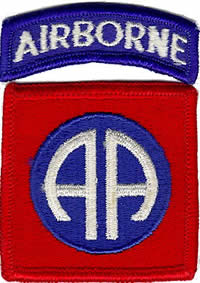
The shoulder patch of the 82nd Airborne Division, two white letters “AA” (for “All Americans”) on a blue circle in a red square.
 Battle order of the 82nd Airborne Division on D-Day Battle order of the 82nd Airborne Division on D-Day |
Composition of the D-Day serials |
| After Action Reports – June 1944 |
Pathfinders of the 82nd Airborne Division on D-Day |
- Creation of the 82nd Airborne Division
Originally, the 82nd Division is a regular infantry division, which was founded on 25 August 1917 in Camp Gordon, Georgia. The division was sent to France during the First World War and participated in no less than three major offensives that precipitated the fall of the German armies.
On August 15, 1942, the US Army first created an airborne division by transforming the 82nd Infantry into 82nd Airborne. It is under the command of General Omar Bradley and his deputy, Brigadier General Matthew Ridgway, and is based in Camp Claiborne, Louisiana, together with the 101st Airborne Division.
Initially composed of an infantry regiment (PIR) and two Glider Infantry regiments (GIR), the 82nd Airborne is reinforced once housed in its new premises of Fort Bragg in the State of Carolina to be finally composed of the 504th and 505th PIR, the 325th GIR, the 319th and 320th Glider Field Artillery battalions (GFAB), the 376th and 456th Parachute Field Artillery battalions (PFAB), the 80th Airborne Anti-Aircraft Battalion (AAAB), the 370th Airborne Engineer Battalion (AEB) and various supporting elements.
After many training sessions, the 82nd Airborne Division was sent from Fort Bragg to Casablanca, Morocco, where it arrived on 10 May 1943. It was to be trained hard to invade Sicily, operation Husky.
- Operation Husky
This operation is led by Colonel James Gavin, the commander of the 505th PIR. It is the first airborne offensive in the military history of the United States of America: on July 9, 1943, the paratroopers of the 505th PIR are dropped over Sicily. Separated into various battle groups, the paras prepares the ground before the amphibious operation that must follow at Gela. The 504th PIR was to be parachuted on 11 July over Sicily. But when the US airmen flew over the Allied fleet, the sailors confused them with enemy bombers and opened fire with their anti-aircraft guns: 23 C-47 Dakota aircraft were destroyed. 81 paratroopers were killed, including the Assistant Commanding Officer, Brigadier General Charles Keerans.
On Sicilian soil, Operation Husky is a success: in 5 days, the 82nd has traveled nearly 94 kilometers and made about 23,000 prisoners.
- Operation Avalanche
General Clark, commander of the 5th US Army, is due to launch an amphibious attack called Operation Avalanche in Salerno. On September 9, 1943, the landing began and for four days, the American bridgehead was threatened. Clark therefore calls on the 82nd Airborne Division, still in Sicily. On September 13th is organized an airborne raid led by Colonel Reuben Tucker and part of the 504th PIR on the town of Paestum south of Salerno. The next day, it was the turn of the 505th PIR to be parachuted. Paratroopers of the 82nd repel the enemy forces.
During the next two months, the 82nd fight in the region of Salerno and Naples, in which the airborne division is the first to enter. It continued its advance to the Volturno River and was sent to England as part of the preparation for Operation Overlord.
However, the 504 PIR remained in the region of Anzio where it continues to fight the enemy (as part of Operation Shingle) and to force it retreat.
- D-Day – Normandy
The 82nd is now in England but amputated from one parachute infantry regiment, it is decided that this airborne division must be reinforced by two new regiments, the 505th and the 507th PIRs.
The 82nd Airborne Division was to conquer various targets during the night of June 5-6, 1944 as part of Operation Neptune attached to Operation Overlord.
Thus, in the early hours of June 6, 1944, paratroopers of the 82nd Airborne jumped on Normandy: they were responsible for capturing various targets west of the allied amphibious invasion zone, such as the town of Sainte-Mère-Eglise or the La Fière bridge.
Parachutes, like the 101st Airborne Division, are unclear and often American soldiers land many kilometers from their target. On the morning of June 6, the parachuted troops made the junction with the landed troops coming from Utah Beach and belonging to the 4th Infantry Division.
On June 9, 1944, in the sector of La Fière, the soldiers of the 82nd, and in particular the men of the 325th GIR, fiercely defended the bridge that German tanks wanted to control again.
Thus the 82nd Airborne Division fought for 33 days in Normandy, until the beginning of July 1944 and received for its actions of bravery the Presidential Unit Citation. But the war is not over, and if the 82nd is withdrawn from the front and returned to England, it is precisely to prepare a new offensive in Europe.
Back to the American ground forces in Normandy menu