
Landing Ship Infantry (LSI)
History, technical sheet and photo
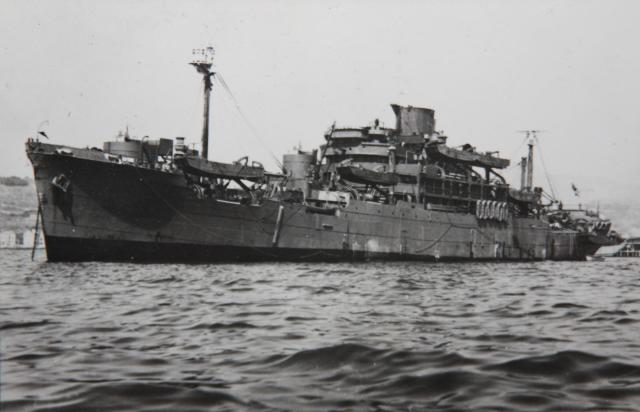
Landing Ship Infantry HMS Glengyle. Photo: IWM
- History of the Landing Ship Infantry
At the start of the Second World War, the Allies (primarily the British) realised they needed to project troops onto hostile shores to liberate Europe. Unlike conventional cargo ships, they required vessels capable of carrying large numbers of troops with their equipment, launching their own landing craft (LCAs – Landing Craft Assault), and maintaining enough speed to sail within military convoys. Lacking purpose-built specialised ships from the outset, the British requisitioned and converted civilian liners, fast ferries, and passenger ships.
The Landing Ship Infantry (LSI) was not a beaching craft (it did not run aground) but rather an intermediate transport. Massive davits were fitted across the decks to suspend and lower landing barges fully laden with soldiers. Depending on their size, they carried between 800 and 1,800 men and were fitted with anti-aircraft weaponry (40mm Bofors or 20mm Oerlikon guns) for protection during the lowering phase, when they were highly vulnerable.
The LSI operated according to a specific protocol: it would halt a few miles offshore (the “Lowering Position”). There, soldiers would board the landing craft suspended from the ship’s sides, which were then lowered into the water to make their way to the beach.
From 1941, LSIs served as mobile bases for commando raids on occupied coasts, such as Operation Archery against German installations in Norway. This experience proved the effectiveness of transforming fast civilian liners into assault transports capable of striking by surprise before withdrawing quickly. In 1942, Landing Ship Infantry played a decisive role in Operation Torch in North Africa, where they landed thousands of British and American soldiers simultaneously on the Moroccan and Algerian coasts. This campaign served as a testing ground to refine barge-lowering techniques under enemy fire.
Subsequently, they were at the heart of the invasions of Sicily during Operation Husky, and then mainland Italy at Salerno and Anzio. In Mediterranean waters, their cruising speed—superior to that of standard cargo ships—was a vital asset in evading Axis submarine attacks.
Beyond Europe, LSIs were also deployed in the Indian and Pacific Oceans by the Royal Navy and the Royal Australian Navy. They took part in the invasion of Madagascar in 1942 to prevent the establishment of Japanese bases, and later, Australian ships like HMAS Manoora led complex amphibious assaults in New Guinea and the Philippines. In these sectors, LSIs were often the only vessels capable of transporting troops over vast distances while maintaining immediate landing capabilities.
Finally, outside of purely offensive phases, these ships sometimes served as fast troop transports for evacuations or emergency garrison transfers. Their hybrid design—both a spacious transport ship and a base for small craft—made them the most versatile units of Allied amphibious warfare, acting as nerve centres capable of managing human logistics from departure until the final yards before the enemy sand.
The Landing Ship Infantry was the logistical pivot of the initial assault during the Normandy Landings. As part of Operation Neptune, approximately 55 of these ships, mostly British and Canadian, served as deployment platforms for elite troops. Their mission began with the Channel crossing from southern English ports, carrying up to 1,500 soldiers each in relatively comfortable conditions compared to small barges, allowing the men to arrive on-site with minimal fatigue.
Thus, the Landing Ship Infantry was the missing link between the port of departure and the landing beach. Without the rapid conversion of these civilian liners into assault barge carriers, the Allies would never have been able to launch invasions of such magnitude before the mass arrival of specialised warships in 1944.
The three main classes of Landing Ship Infantry:
– LSI(L) – Large: Liners of over 10,000 tons (e.g., HMS Glengyle).
– LSI(M) – Medium: Mid-sized vessels (e.g., HMS Prince Henry).
– LSI(S) – Small: Often fast ferries (e.g., HMS Princess Beatrix), ideal for rapid raids.
- Technical Specifications: LSI (Landing Ship Infantry) Large, HMS Glenroy type
Originating/Operating Country: United Kingdom / Commonwealth (some built in the USA under Lend-Lease)
Designation: Landing Ship, Infantry (LSI)
Complement: Approximately 250 to 300 sailors (including ship’s crew and landing craft crews)
Propulsion: 2 Diesel engines (Doxford or Sulzer type) developing approx. 12,000 hp
Capacity: 800 to 1,500 infantrymen and 12 to 24 landing craft (LCA)
Armament: 1 x 4-inch (102 mm) gun, 2 x 40 mm Bofors guns, and up to 12 x 20 mm Oerlikon guns
Displacement: 10,000 to 12,000 tons
Speed: 14 to 18 knots
Length: 150 to 160 m
Beam: 20 to 21 m
 Back to the Allied warships menu