
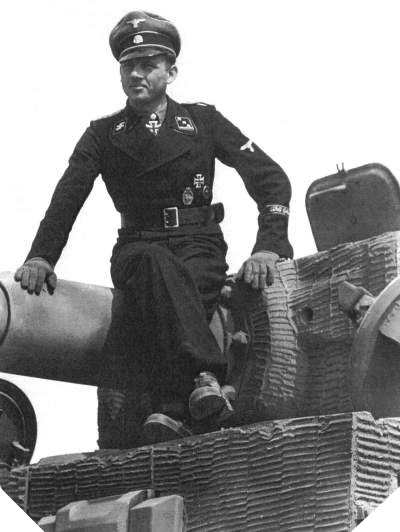
Michael Wittmann
Biography
Michael Wittmann was born on April 22, 1914, in Vogelthal, Upper Palatinate, Germany.
The son of a farmer, Michael joined the Reich Labor Service (Reichsarbeitdienst), the German labor corps, in 1934, where he worked for six months. In October of the same year, he enlisted in the 19th Infantry Regiment as a private. In 1937, he joined the elite Leibstandarte SS Adolf Hitler division, where he received training on armored vehicles (Sd.Kfz.222 and Sd.Kfz.232). He quickly proved himself an excellent driver.
After stints at various armored vehicle training centers, such as the 17th Reconnaissance Squadron, he joined an Sd.Kfz.232 reconnaissance tank section in September 1939 as a non-commissioned officer and took part in the Polish campaign.
At the end of 1940, after several transfers to various German bases, Michael Wittmann began his true career as a tank driver in the Balkans, serving until mid-1941 in Yugoslavia and Greece, where he commanded a section of Sturmgeschütz III tanks.
On June 11, 1941, Wittmann was transferred to the Eastern Front as part of Operation Barbarossa, which began on June 22. Fighting south of the Russian front, he was wounded in action during the summer of 1941. Among his decorations, Michael Wittmann received the Panzer Assault Medal for destroying six Soviet tanks in a single engagement in September 1941.
In early spring 1943, he was given command of a Tiger tank company. His baptism of fire in a Tiger tank took place during Operation Citadel, which targeted the city of Kursk. During the first day of the attack, Wittmann destroyed thirteen Russian T-34 tanks and two anti-tank guns. His actions prevented the destruction of Helmut Wendorff’s platoon, which was under heavy fire. In total, by the end of this operation, Wittmann had destroyed 30 Russian tanks and 28 anti-tank guns. By October 13th, he had destroyed 20 more T-34 tanks and twenty-three additional guns. His gunner was Balthasar Woll, nicknamed Bobby.
Michael Wittmann quickly became a celebrity in Germany.
In May 1944, Wittmann was transferred to Lisieux, Normandy, a month before the D-Day landings. Between June 6 and 12, 1944, he advanced towards the Normandy front with his 2nd Company of the 101st SS Heavy Panzer Battalion. Allied air attacks decimated his company, which was left with only six Tiger tanks. He was subsequently reinforced by units from the Panzer Lehr and 12th SS Hitlerjugend divisions.
He engaged in fierce fighting on June 13, 1944, northwest of Caen, in the Tilly-sur-Seulles sector. During that day, he completely destroyed the British 4th County of London Yeomanry regiment on the D175 road, near Hill 213. The fighting continued as far as the village of Villers-Bocage.
On June 25, 1944, Wittmann was decorated by Hitler, making him the most decorated of all Nazi tank commanders. The German High Command then offered him command of a tank driver training school, but Michael Wittmann refused and returned to Normandy in July 1944, to the Caen area.
On August 8, another tank battle took place near the village of Cintheaux. At 12:55 PM, SS-Hauptscharführer Höflinger reported that he was to the right of Wittmann’s tank, in a field near the Caen-Cintheaux road, when Michael Wittmann’s tank was destroyed. All its occupants were killed instantly. After the exchange of fire between the Allies and Germans, Wittmann’s body and those of the Tiger’s crew were buried next to the tank’s wreckage.
The cause of his death remains unexplained: numerous units, such as the 1st Polish Armoured Division, the 4th Canadian Armoured Division, and the British Independent 33rd Armoured Brigade, claim responsibility for the ambush that trapped Wittmann. The official version states that his tank was destroyed by a bomb dropped by an Allied aircraft. The exact cause of his death fuels considerable controversy.
It was only in 1983 that his body was recovered during road construction. He and his crew are buried in the German military cemetery at La Cambe in Normandy.
 Back to the German military personnel biographies menu